

New paper: the evidence for learning podcasts, and where they work best
An unregistered guide for L&D and education leaders sets out what audio-first learning does well, what it doesn't, and ten questions to answer before committing.
Podcasting is arriving in learning and development faster than the evidence base that would help learning professionals use it most effectively. A new paper published this week aims to close that gap.
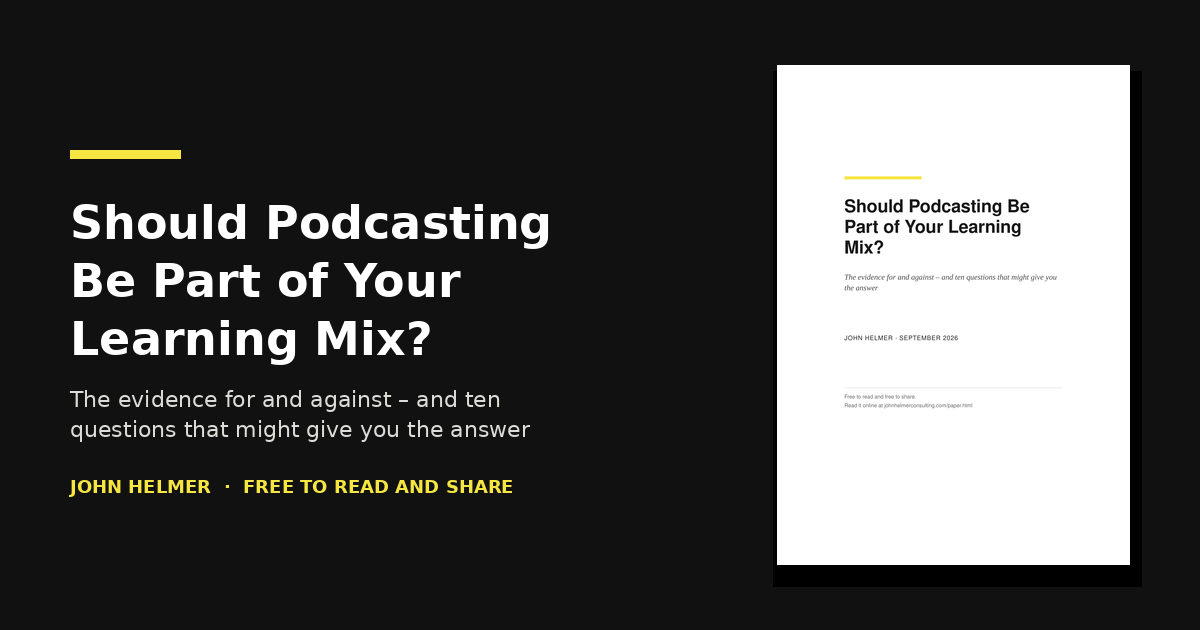
Should Podcasting Be Part of Your Learning Mix? is a free guide for anyone weighing up audio as part of their learning provision. Written by John Helmer, a producer with more than 200 episodes across four learning podcasts and co-host with Donald Clark of the Great Minds on Learning podcast about learning theory, the paper sets out what the cognitive science supports about learning through audio. It pinpoints where the medium's real strengths lie, and where it is less effective. It ends with ten questions readers can answer about their own organisation.
The paper's central argument is that audio does things the rest of a learning mix cannot. It accesses learner time that screen-based media can't reach – the commute, the walk, the drive between sites – which matters particularly for the large proportion of the workforce that does not sit at a desk. It carries unusual levels of trust. And the interview format draws knowledge from subject matter experts (a notoriously difficult thing to do) in a more approachable and digestible way, often, than written material can.
The paper is equally specific about fit. Podcasting maps well onto leadership and manager development, behavioural and soft skills, and change communication, where judgement and worked reasoning matter more than precision. It maps badly onto many types of compliance, technical training and anything procedural, where the transient nature of spoken material works against the learner.
'This is a young practice and it's growing quickly,' said Helmer. 'Though there have been some academic studies, what I haven't yet seen is somebody sitting with the research and working out what audio-first learning is actually best at bringing to the many demands made on learning teams today. I wanted to give people something they could take to a budget conversation or a meeting with stakeholders.'
The paper also examines claims in circulation that the underlying research does not support – including the widespread idea that Richard Mayer's work on multimedia learning justifies audio-only delivery, and the belief that audio produces better long-term retention than visual material. Helmer notes that he has repeated the second of these himself from a conference stage.
'A podcast has to earn its place in a mix that's usually already full, so the honest question is what it would displace and whether that trade-off helps learners,' said Helmer. 'Sometimes the answer is no, and I think it's important to say that. But when the answer is yes, it's worth doing properly – and the evidence for what "properly" looks like is better than most people realise.'
Separate sections address corporate L&D, higher education and vocational education, mapping podcasting against the frameworks each sector uses, including Gagné's learned capabilities, the revised Bloom knowledge dimension, constructive alignment, threshold concepts and the European Qualifications Framework. The paper notes that practice in vocational and higher education, particularly in Northern Europe, is in several respects ahead of UK corporate adoption.
Interest in the field has been building. The Podcast Learning Festival ran in London earlier this year, and specialist providers have emerged to service organisational demand.
Should Podcasting Be Part of Your Learning Mix? is available to read online and download as a PDF at johnhelmerconsulting.com/paper.html. There is no paywall, registration form or follow-up sequence, and readers are encouraged to share it.
ENDS
Notes to editors
About the paper
Should Podcasting Be Part of Your Learning Mix? The evidence for and against – and ten questions that might give you the answer. 27 pages, approximately 8,400 words. Published 18 September 2026. Free to read, download and share.
Online: https://johnhelmerconsulting.com/paper.html
PDF: https://johnhelmerconsulting.com/should-podcasting-be-part-of-your-learning-mix.pdf
About John Helmer
John Helmer is a podcast producer, host and consultant specialising in audio for learning. He spent 25 years in digital learning before becoming a full-time producer and consultant in 2019.
He hosts four shows: The Learning Hack; Great Minds on Learning with Donald Clark; Learning Leaders, from NIIT in association with Learning Hack; and The Tech Imaginarium, with Ezri Carlebach. Across them he has recorded more than 200 episodes, with 145,000+ lifetime downloads, 45,000+ views on YouTube, and listeners in 175 countries. The Learning Hack is ranked by Listen Notes in the top 5% of podcasts globally for listens.
He is a keynote speaker at the SLASK Conference in Denmark, and has spoken at Learning Technologies in London and the Podcast Learning Festival.
Consultancy
John Helmer advises organisations on whether and how to use podcasting for learning, at johnhelmerconsulting.com.
Press contact
[email protected]
Booking a conversation: https://calendly.com/johnhelmer/30min
LinkedIn: https://www.linkedin.com/in/johnhelmer
Images available on request: headshot, paper cover.