

Workers report falling access to L&D as AI use rises
PwC's survey of almost 50,000 workers finds access to L&D fell from 59% to 51% as workplace AI use increased.
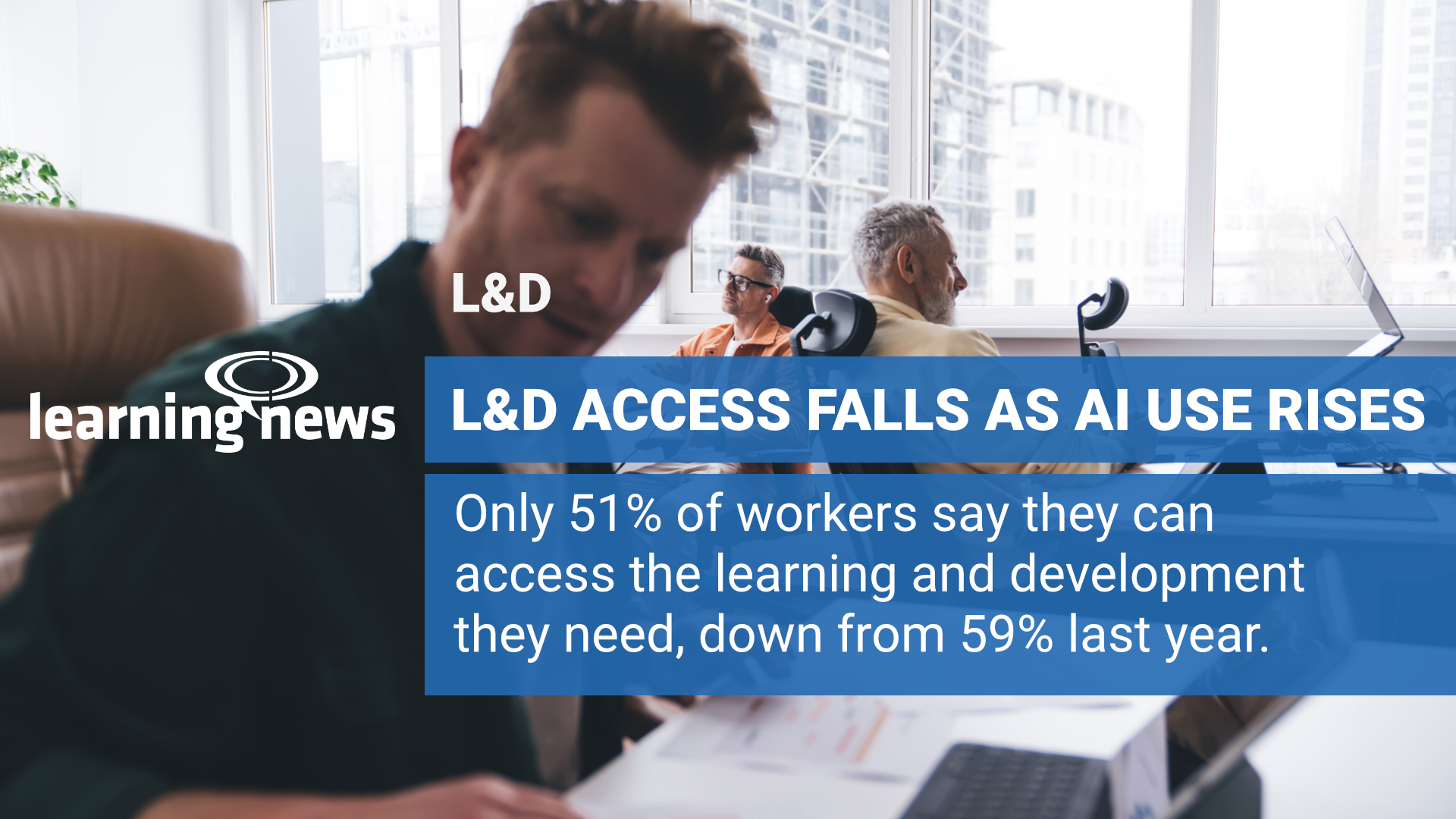
Workers are reporting less access to learning and development as AI use at work continues to increase, according to a PwC survey of almost 50,000 workers worldwide.
Just 51% said they have access to the learning and development resources they need, down from 59% last year.
At the same time, 64% said they had used AI at work during the previous 12 months, an increase of 10 percentage points.
PwC surveyed 49,364 workers across 48 countries and regions and 29 sectors in May and June 2026. Responses were weighted to the working population's gender and age distribution in each country or region.
The requirement to adapt is also increasing. Forty per cent of workers said they had applied new skills in their job to a large or very large extent during the past year.
Senior executives and managers reported more change in the skills they were applying than other groups. Fifty-one per cent of senior executives and 46% of managers said they had applied new skills to a large or very large extent, compared with 29% of non-managers and 38% of entry-level workers.
PwC divided respondents into four groups according to the scarcity of their skills and their progress in using AI. Its largest group, labelled the 'engine room', represents 56% of workers whose skills are less scarce and who are not far along the AI learning curve. Only two in five workers in this group said they have access to the learning and development resources they need.
Workers using AI daily also reported greater confidence in their ability to learn new skills, job security and management than infrequent users. The survey shows an association between these measures and AI use, rather than establishing that AI use caused the differences.
PwC's 'front-runner' group, representing 14% of respondents with scarce skills and strong AI capabilities, reported greater mobility. Twenty-nine per cent said they were very or extremely likely to change employer in the next year.
The survey records a workforce being asked to adapt to new technology and apply new skills while reported access to development is moving in the opposite direction.
Pete Brown, global workforce leader at PwC, said: ‘organisations face a challenge in continuing to develop workers making greater use of AI ‘but not at the expense of the rest of the workforce’.
‘There is a real risk that the global workforce is starting to move at different speeds.’
Brown goes on to say that more than half of workers are not benefiting from AI and skills in the same way, while workers with scarce skills and stronger AI capabilities are becoming more confident and mobile.
Key stats
- 64% used AI at work in the previous 12 months, up 10 percentage points
- Daily generative AI use rose from 14% to 22%
- 51% say they have access to the L&D resources they need, down from 59%
- 40% say they applied new skills in their job to a large or very large extent during the past year
Links
Get the report: 2026 Global Workforce Hopes and Fears Survey