

AI skills spread as work changes within jobs
New US labour market data shows AI skills becoming more widespread as work changes within jobs and new firm AI adoption slows.
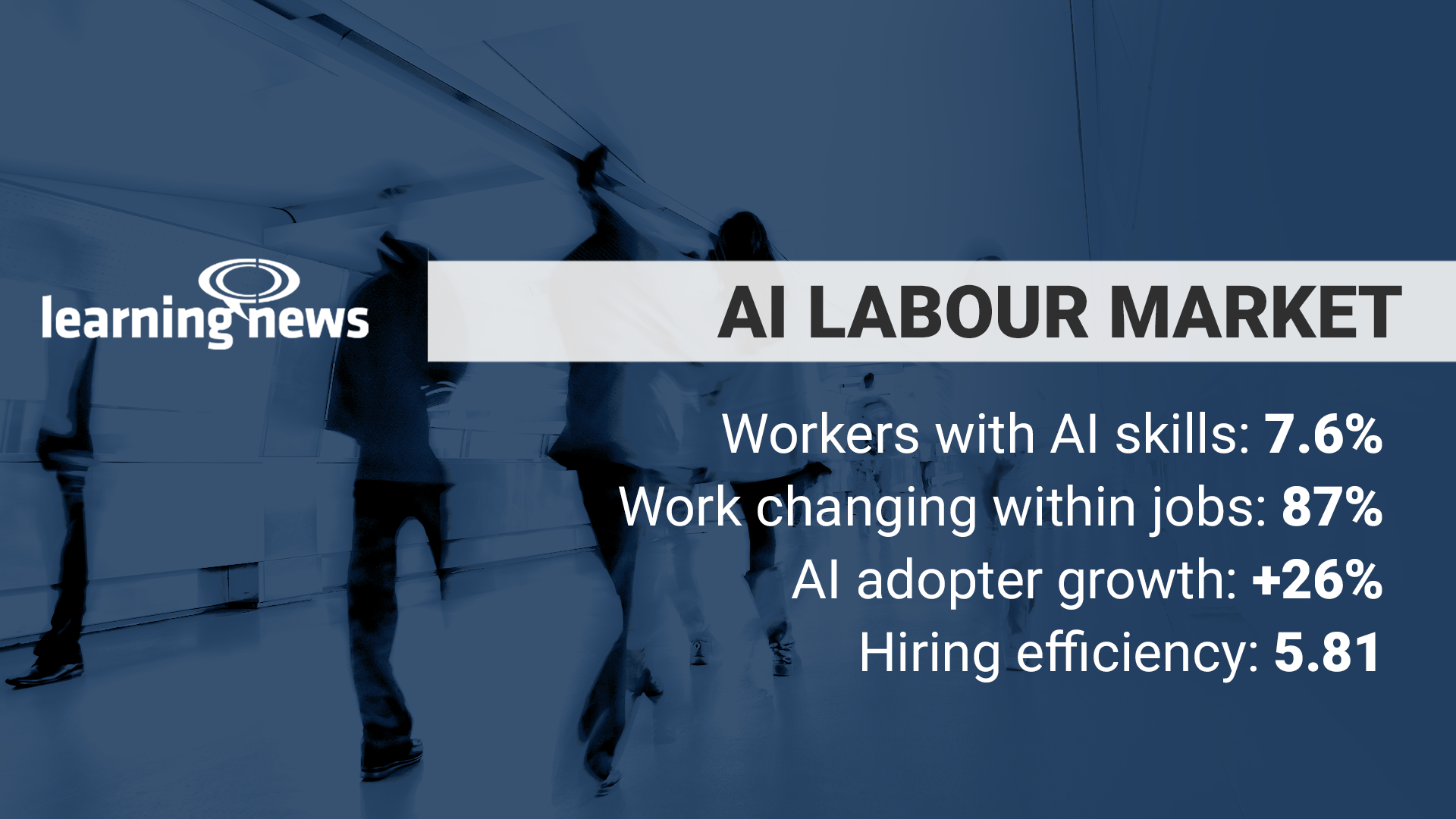
AI skills, job transformation, organisational growth and hiring efficiency across the US show that AI skills are becoming more widespread across the US workforce while most changes in work are taking place within existing occupations, according to the second AI Labor Market Tracker from Revelio Labs.
The latest data also shows slower growth in the number of new AI-adopting firms, continued weakness in junior AI-exposed occupations, and a further rise in the number of job postings needed to make a hire.
Workers with AI skills: 7.6%
Are AI skills becoming more widespread?
Workers with at least one reported AI skill held 7.6% of US job positions in July 2026. Revelio Labs identifies around 80 AI and machine-learning skills, ranging from machine learning and neural networks to large language models, prompt engineering, and AI frameworks.
Work changing within jobs: 87%
Where is work changing?
Most changes in work are happening inside existing occupations rather than through changes in the mix of jobs. Revelio Labs estimates that 87% of year-on-year activity change occurred within occupations, compared with 13% resulting from shifts in the occupation mix.
The measure indicates that job titles and occupations can remain stable while the activities performed within them change.
‘When 87% of activity change happens inside occupations, job titles become a poor measure of how much work has actually changed,’ notes behavioral scientist Dr. Gleb Tsipursky, author of The Psychology of AI Adoption at Work.
Junior AI-exposed employment
Are younger workers being affected differently?
Demand remains weaker for occupations containing work most exposed to AI, with the decline concentrated at junior levels. Employment among workers aged 22–25 in the most AI-exposed occupations is 19% lower relative to the least-exposed occupations than before ChatGPT, compared with a 5% relative decline for older workers.
Commenting on the long-term risk this poses to workplace skill development, Dr. Tsipursky warns that employers must evaluate how these shifting task mixes impact entry-level growth:
‘Companies should stop asking whether AI changed a job title and start measuring which activities disappeared, which judgment tasks expanded, and whether junior employees are still getting the practice needed to become independently competent. That is where workforce redesign either builds capability or quietly hollows it out.’
AI adopter growth: +26%
Are AI adopters growing faster?
AI-adopting firms recorded headcount growth 26% higher than non-adopters, compared with 27% in the previous tracker.
The pace at which firms are newly adopting AI has slowed. The number of new AI-adopting firms per month is 39% below its April 2026 peak, although cumulative adoption continues to increase.
Hiring efficiency: 5.81
Is capability easier or harder to find?
Employers require 5.81 job postings for every external hire. The ratio has been rising for six years, a trend that predates ChatGPT.
Work and capability change
The latest indicators show AI capability spreading through the US workforce while the activities performed inside jobs continue to change. AI-adopting firms are still growing faster than non-adopters, although new adoption has slowed. Younger workers are seeing a larger relative employment decline in occupations containing work most exposed to AI.
Source: Revelio Labs AI Labor Market Tracker, August 2026.