


Overcoming the barriers to AI adoption in your organisation (using the Spice Girls)
Acteon's Rebecca Trigg uses a playful framework inspired by the Spice Girls to explore the different responses to AI adoption in organisations – and explains why understanding people, not technology, is the key to lasting change.
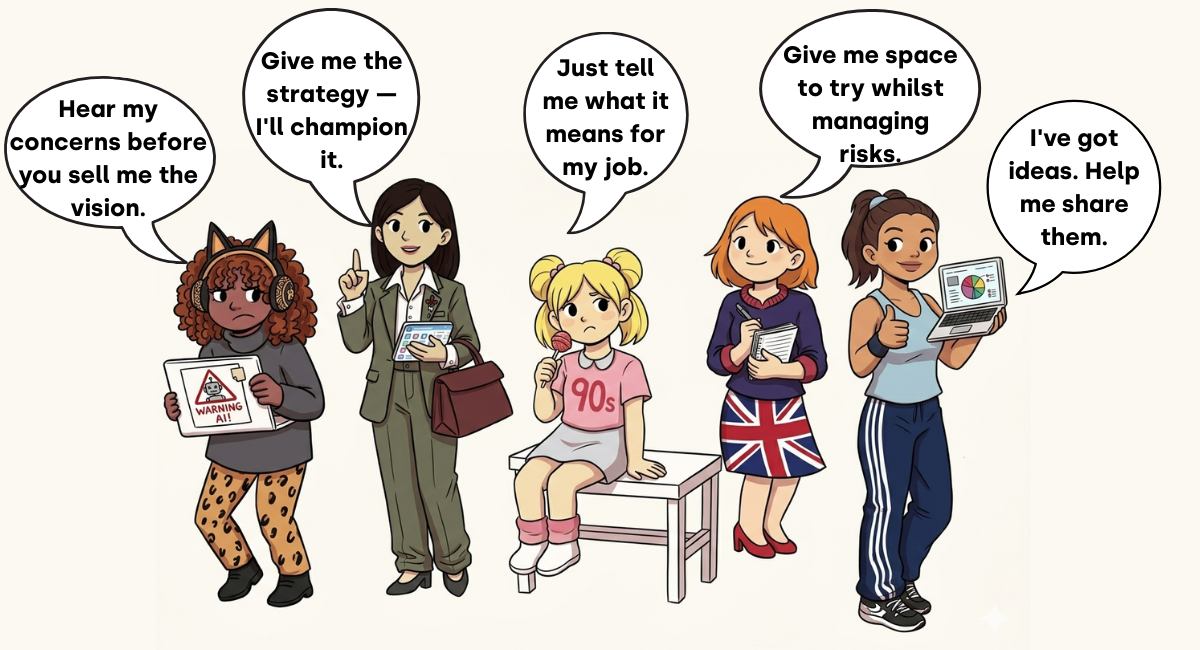
Most people's feelings about AI aren't fixed. They shift depending on what they've read, what they've tried, and what kind of day they're having. That spectrum is real. It matters.
Drawing on her experience at Acteon designing learning experiences that support organisations to change behaviour at scale, Rebecca has identified five attitudes to AI adoption. She maps them – with a knowing nod – to the Spice Girls.
Scary – "We are doomed"
The fearful response: Rebecca has been Scary Spice. Not just about the potential for massive job losses (well, not only about that), but about something subtler: the worry that outsourcing thinking to AI might quietly hollow out the creative muscles that took years to build.
Fear like this doesn't make people awkward obstructors – it makes them human. And if organisations treat it as a communication problem to be managed, rather than a real concern to be heard, they'll lose people before they've even started.
Posh – The corporate hero
AI framed as the great accelerator – the efficiency multiplier that dominates strategy decks and keynote speeches.
There's nothing wrong with that story – it's often true – but it can float quite some distance above the actual experience of the people being asked to change how they work. Optimism from the top is essential. But if it's the only story being told, people start to feel like props in someone else's transformation narrative.
Baby – Blissfully unaware
For many, AI simply hasn't landed in their day-to-day work yet. This isn't cynicism – it's disconnection. The risk is that "I'll get to it eventually" quietly becomes never. The opportunity here, is to connect the right tools to the right tasks for the right people, building awareness of what's in it for them right now.
Ginger – Using AI… gingerly
Curious enough to try things, anxious enough to second-guess them. Rebecca admits this is where she spends a lot of her time. She uses AI to plan trips, handle admin, and process the kind of reading that used to take up hours of mental energy. And she loves it for that.
But she's more careful about where she lets it into creative work. She's noticed that a plausible first draft has a way of killing the appetite for the better thing she might have written starting from nothing.
The Gingers in your organisation are your biggest opportunity. They just need to feel safe enough to experiment.
Sporty – Using AI like a pro
Every organisation has early adopters who've already built custom AI workflows before the official guidance arrived. The challenge is ensuring their energy translates into shared practice across the wider team, rather than remaining an impressive but isolated bubble.
Say you'll be there – for your people
Here's what Rebecca keeps coming back to: AI adoption isn't really an AI challenge. It's a behaviour change challenge.
At Acteon, the team helps individuals and organisations work out which actions, choices and habits will have the biggest impact against a real objective.
When it comes to AI, that means thinking clearly about:
- Motivation – Do people actually want to change?
- Capability – Do they have the skills and confidence?
- Opportunity – Does the environment support new behaviours?
The organisations getting this right aren't those with the biggest AI budgets – they're the ones treating adoption as a human challenge. As Rebecca puts it: "The technology is rarely the bottleneck. People are."
Acteon helps organisations understand where their people sit on this spectrum and identify the unique barriers to AI adoption, then put practical plans in place to support each group – whether that means addressing fear, building confidence or giving early adopters a bigger platform.
Find out more about how Acteon helps organisations with AI adoption here.