

Behaviour before measurement: Anna Barnett on closing the intention-action gap
Mindtools Kineo's Anna Barnett examines the gap between intention and action and the role of behavioural design in closing it.
Learning and development teams have spent years refining methods to measure learning impact. From evaluation models and ROI studies to learning analytics and skills data, the focus has often been on demonstrating that behaviour change has occurred and that business outcomes have followed.
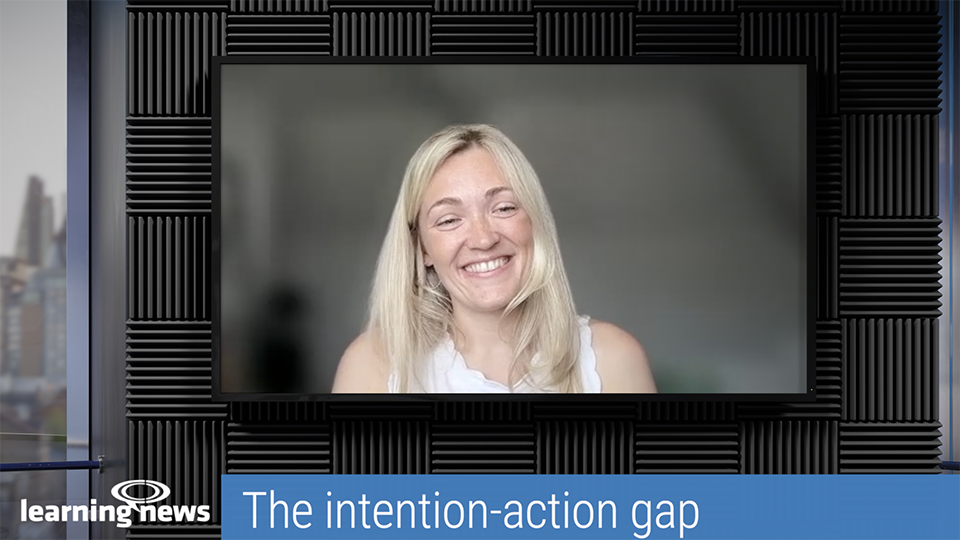
Anna Barnett, Head of Research and Insights at Mindtools Kineo, believes organisations may be approaching the challenge from the wrong direction.
Speaking to Learning News, Barnett argues that many workplace learning programmes successfully create intention but fail to help learners translate those intentions into action once they return to work.
'The challenge and the problem that we have is not forming intentions,' she says. 'We're all good at that, but actually it's the acting on it and doing so consistently.'
Barnett points to decades of behavioural science research showing that intention and behaviour are not the same thing. Employees may leave a programme motivated to apply what they have learned, yet workplace pressures, routines and habits can prevent those intentions becoming sustained behaviours.
This distinction matters because business outcomes depend on behaviour change rather than learning alone.
'When people leave a learning programme, they can be genuinely committed to doing something different and still never manage to do it,' Barnett says.
Rather than concentrating solely on measuring outcomes, she argues that learning teams should pay greater attention to the behavioural steps that sit between learning and organisational results.
A key part of that approach is designing for what Barnett describes as 'moments of action' rather than simply moments of learning.
She highlights the use of implementation intentions, a behavioural science technique that links a future situation to a specific action. Instead of asking learners what they intend to do differently, learning designers can encourage them to create simple plans using an 'if X happens, then I will do Y' structure.
For example, a manager might decide: 'If I start a weekly team meeting, then I will ask one coaching question before I offer my opinion.'
The approach helps reduce reliance on memory and willpower by connecting desired behaviours to existing routines and workplace triggers.
Barnett argues that such interventions can be highly effective despite their simplicity.
'There's a lot of evidence that even these very deliberate if-then statements can help follow through by a huge amount,' she says.
The wider implication for workplace learning is that behaviour change is more likely when learners are supported at the point where action needs to occur.
'We're still talking about learning creating value when behaviour changes,' Barnett says. 'But behaviour change is significantly more likely when people plan for the moment that they need to act. So that's where I think we should be supporting them.'