


Why People Learn Best When They Experience, Not Just Observe - Lessons from Óbidos
This month, we’re delighted to be featuring an insightful article from Revolve, exploring why people learn best when they experience rather than simply observe - and how immersive learning creates insight that truly sticks.
In March, we’ll be coming together at Dolce CampoReal Lisbon for the People Development Summit. While our schedule might not leave much time to explore the surrounding towns and sampling the offerings at local vineyards, it’s still a great opportunity to notice what’s around us, and what there is to learn, simply by being present and paying attention.
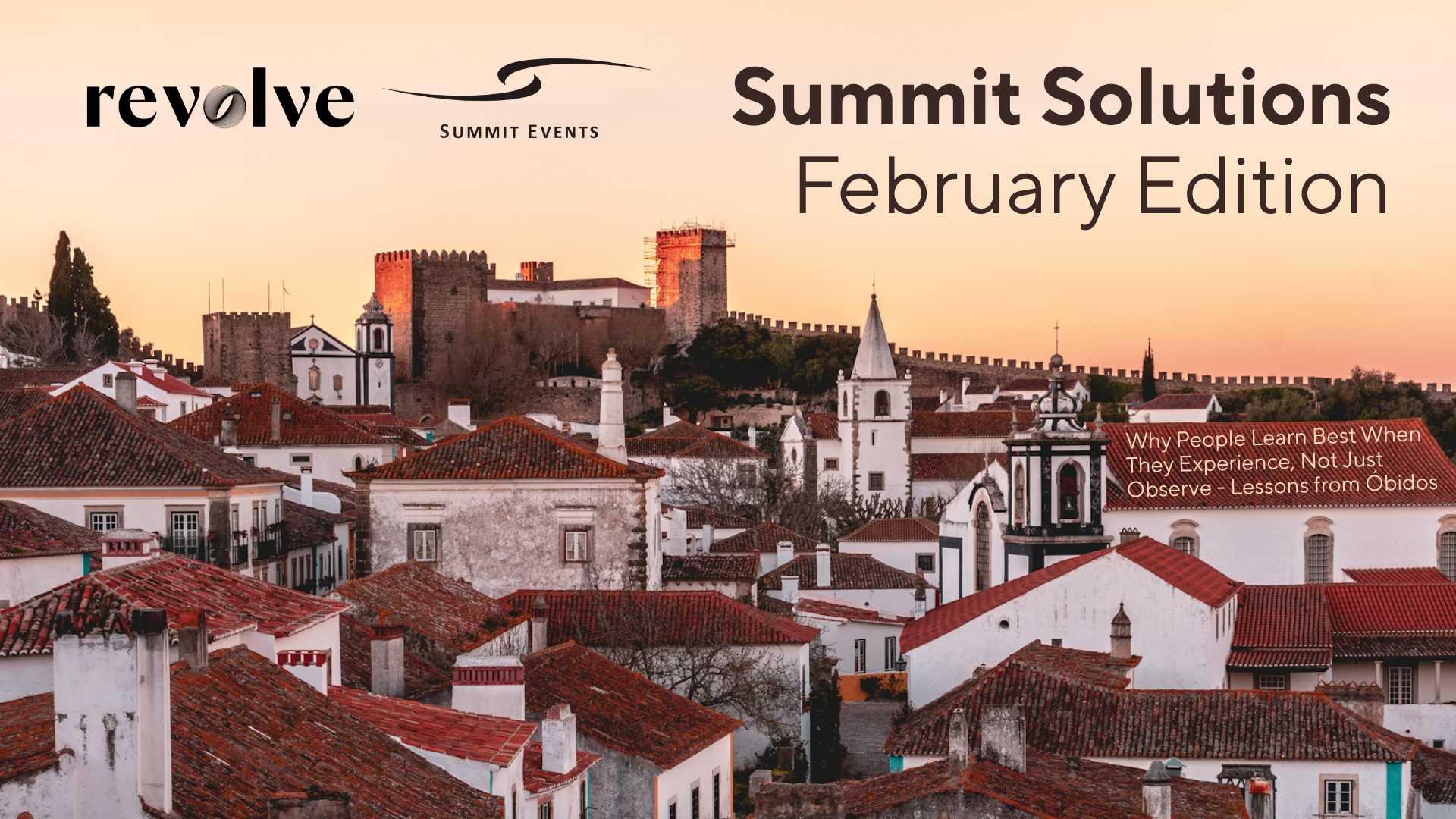
Take Óbidos, for example, a medieval town just an hour away. On paper, it’s a collection of cobblestone streets, colourful houses, and a breathtaking castle. But the real lesson comes from what happens when you step into it. Every year it sees hundreds of tourists come to experience its historical beauty. Walking the streets, passing through the castle gates, or noticing the small shops tucked into ancient buildings turns history from something you read about into something you feel. You don’t just observe it, you experience it. And that can make all the difference.
That distinction between observing and experiencing, is at the heart of how people learn best. We often assume learning happens when information is delivered clearly and efficiently (and of course that’s important). But the lessons that stick, the insights that shape thinking, almost always come from immersion, being involved, asking questions, and connecting with what’s around us. The lived experience will always be more memorable than the hypothetical one.
Óbidos shows this in miniature. Its story, architecture, and atmosphere combine to make history tangible. You don’t need signs or guides to understand the significance; your senses and your curiosity fill in the gaps and it’s not long until you’re imagining the rich history of people that have lived their years in its colourful homes. Learning becomes active, not passive. And the knowledge gained this way doesn’t just live in your head, it becomes part of your experience. Experiences that stay with you.
The same principle applies everywhere, including at the People Development Summit this year. Even if we’re in conference rooms rather than castle courtyards, the lessons are richer when we engage fully, when we participate, explore ideas, and immerse ourselves rather than simply observe. Context matters. Environment matters. Presence matters.
Experiential learning works because it engages more than intellect. It engages emotion, senses, and reflection. When people are involved, when they live the lesson, understanding moves beyond memorisation and it becomes insight that sticks. This is why the best learning, whether in travel, work, or life, is never passive. It moves with you, even if it lives in the peripheral memory, ready to be called in at the appropriate time.
As we gather at Dolce CampoReal, let Óbidos remind us: the most meaningful lessons don’t come from standing on the sidelines. They come from stepping in, engaging fully, and letting the experience shape your understanding.
Whether in history, work, or personal growth, the best experiences aren’t just observed. They’re explored. They’re lived.
To bring this full circle, this belief in learning through experience sits at the heart of what Revolve deliver as long-standing partners of Summit Events. As lead sponsor of the 26th People Development Summit, Revolve will be helping to shape an environment where learning is immersive, practical, and grounded in real-world application-not just theory. It’s this shared philosophy that makes the Summit more than a conference: it’s an experience designed to challenge thinking, spark insight, and leave delegates with learning that truly sticks.