


High Performance Without Burnout: the conversation Reward & Benefits leaders need to have in 2026
Poor mental health now costs UK employers £51 billion a year - yet burnout continues to rise. In this latest Summit Solutions article, Wellbound+ explores why traditional wellbeing strategies may no longer be enough, and what Reward & Benefits leaders should be focusing on instead.
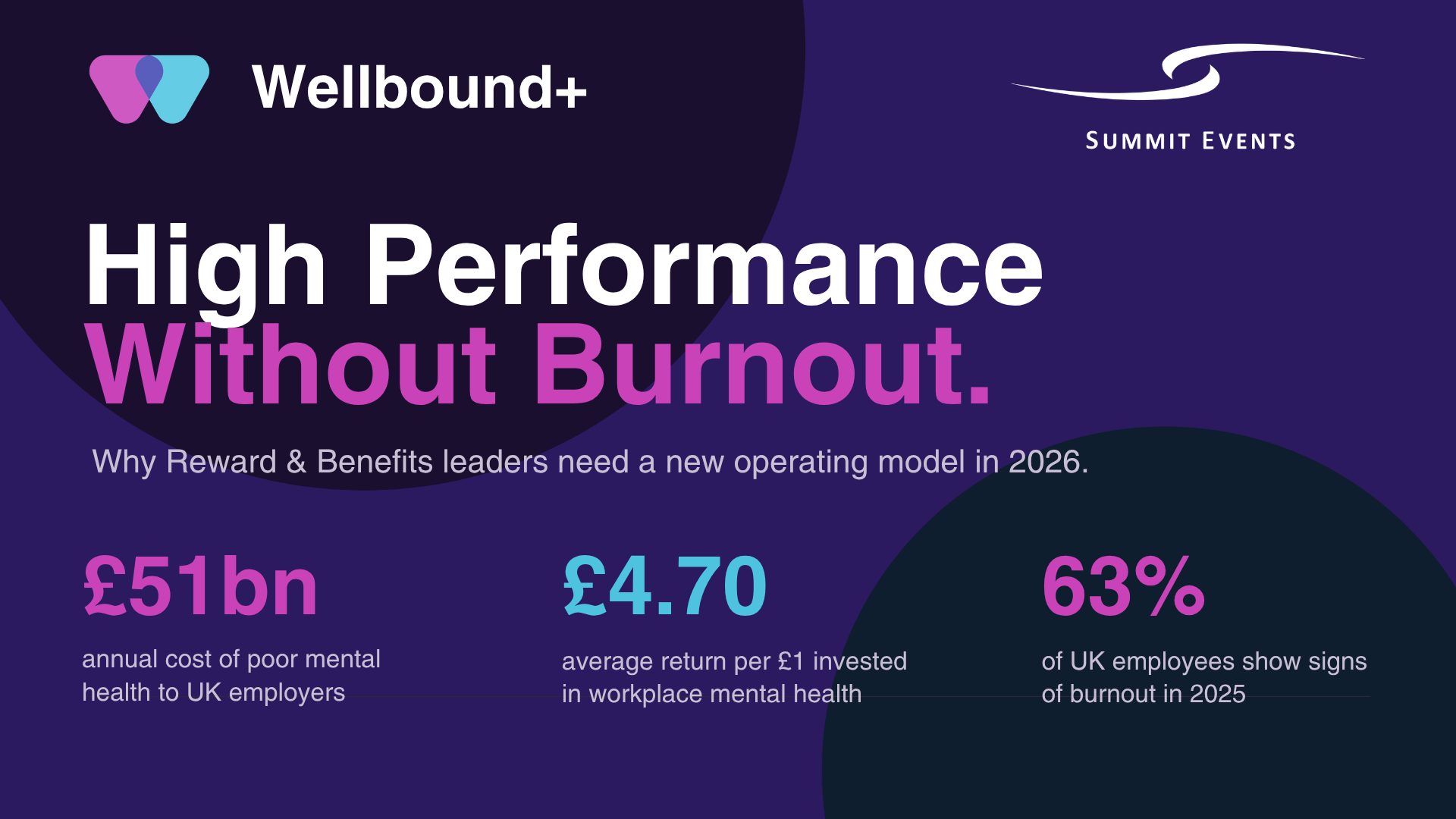
Poor mental health now costs UK employers an estimated £51 billion a year. Presenteeism alone, where people are at work but performing well below capacity, accounts for £24 billion of that. Deloitte's 2024 report found that for every £1 invested in workplace mental health, employers see an average return of £4.70. 1 And yet 63% of UK employees show signs of burnout, up from 51% just two years ago.
For Reward, Benefits and Wellbeing leaders, the question is no longer whether wellbeing matters. The data settled that. The question is why the spend keeps going up while the outcomes keep getting worse
The intensity myth
For years, workplace performance has been associated with intensity: longer hours, constant availability, the ability to keep pushing regardless of personal cost. But many organisations are now recognising a difficult truth. Sustained pressure does not create sustainable performance.
High performance is not about how hard someone can operate for a short period. It is about their ability to perform consistently over the long term, without negatively impacting sleep, cognition, decision quality, relationships or physical health. The World Health Organization formally recognised burnout in ICD-11 as an occupational phenomenon: a syndrome resulting from chronic workplace stress that has not been successfully managed. The language matters. It is occupational. It is caused by how work is designed, not by individual weakness.
“Sustained pressure does not create sustainable performance.”
The evidence base
The evidence now points clearly in one direction. Sleep deprivation produces cognitive impairment comparable to alcohol intoxication. Chronic stress measurably reduces concentration, emotional regulation, creativity and judgement, the precise capabilities organisations claim to value most.
McKinsey Health Institute research across 30 countries found that more than one in five employees globally is experiencing symptoms of burnout, and those employees are three times more likely to leave their jobs. Gallup's 2025 State of the Global Workplace report puts global engagement at 21%, costing the world economy an estimated $438 billion in lost productivity. UK engagement remains among the lowest in the developed world.
This is no longer an HR issue. It is a capital allocation issue.
Why more spend hasn't moved the needle
The standard corporate response has been to add more wellbeing benefits on top of an unchanged operating model. More apps. More webinars. More EAP brochures gathering dust in inductions. The result, for most workforces, is not better wellbeing. It is paralysis through overload.
Employees are bombarded with conflicting advice. Optimise your morning routine. Meditate. Track your sleep. Cold plunge. Cut caffeine. Journal. Breathe. The cumulative effect is not health. It is noise. And in the meantime, the structural causes of burnout (workload, role clarity, manager capability, recovery norms) remain untouched.
What the strongest organisations are doing differently
The organisations building the strongest cultures are starting to recognise that energy management matters as much as time management, and that recovery is part of performance, not separate from it. That means creating environments where:
- Recovery is normalised by leaders, not just permitted on paper.
- Wellbeing is built into the operating model, including how work is designed, scoped and measured, rather than bolted on.
- The wellbeing offer is role-aware. What a field engineer needs is not what a senior partner needs.
- Specialist pathways exist for the issues actually driving cost: menopause, men's health, musculoskeletal injury, mental health.
- Success is measured in business outcomes such as absence, presenteeism and retention, not just app downloads.
The takeaway
The future of high performance will not belong to organisations that extract the most from their people. It will belong to those that understand how to sustain it, and have the discipline to measure whether their wellbeing investment is actually delivering it.
For the Reward, Benefits and Wellbeing leaders at this summit, the most useful question to take back to your business is not “how much should we spend?” but “what are we actually measuring, and would our CFO sign off on the ROI?”
If the answer is uncomfortable, the operating model is the problem. Not the budget.
This article was prepared by Wellbound+ for the Rewards, Benefits & Wellbeing Summit 2026. It is intended as thought leadership for senior Reward, Benefits and Wellbeing decision-makers and does not constitute clinical or financial advice. To discuss any of the themes above, visit wellboundplus.com or contact [email protected].